
Culture: Easily grown in average, medium to wet soils in full sun. In the wild, it is seen growing in moist to wet areas along streams and sloughs as well as in drier glade and prairie areas. Plants generally grow taller in moist soils. Overall plant height may be reduced by cutting back stems in late spring. Easily grown from seed. Remove flower heads before seed develops to avoid any unwanted self-seeding. This species of ironweed tends to hybridize with some other native ironweeds, which can sometimes complicate plant identification.
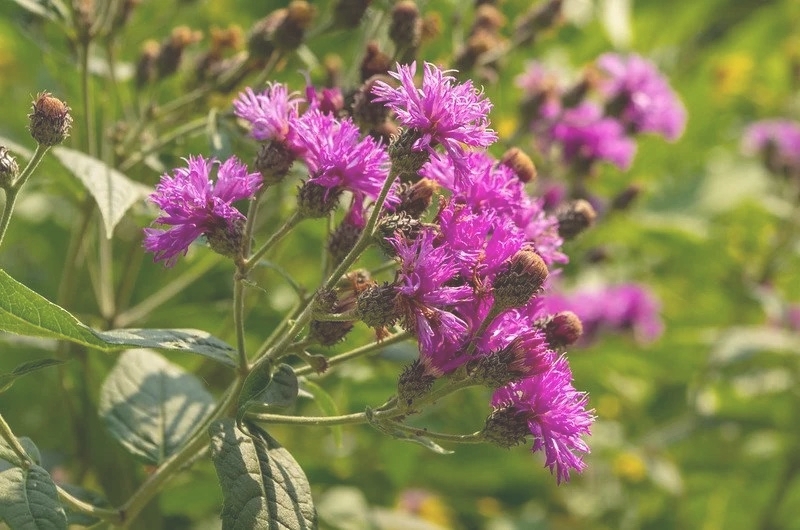
Noteworthy Characteristics: Vernonia arkansana, commonly called curlytop ironweed or Arkansas ironweed, is native from Illinois to Kansas south to Arkansas and Oklahoma. In Missouri, it typically occurs in gravel and sand bars along streams, slough margins, wet meadows, thickets, open woods, prairies and glades primarily in the Ozark region of the state (Steyermark). This plant is noted for its narrow, willow-like leaves, large flowering heads and thread-like tips on the involucral bracts. It is an upright perennial that typically grows on stiff, leafy, nearly glabrous stems which grow to 4-6’ tall in cultivation, but to as much as 10’ tall in the wild. Linear to linear-lanceolate leaves (to 7” long) are usually glabrous. Composite flowers, each with fluffy, pink-purple disks (rays absent), bloom in loose, corymbose cymes from late summer into fall. Flowers give way to rusty seed clusters. The source of the common name for vernonias has been varyingly attributed to certain “iron-like” plant qualities including tough stems, rusty-tinged fading flowers and rusty colored seeds. Notwithstanding its toughness, the plant is, with the exception of its attractive flowers, a somewhat unexceptional ornamental. Flowers are very attractive to butterflies. The within species is synonymous with and formerly known as V. crinita.
Genus name honors William Vernon (d. c. 1711), English botanist who collected in Maryland in 1698. Specific epithet means of Arkansas.
Problems: No serious insect or disease problems.
Garden Uses: Naturalize in cottage gardens, wildflower meadows, prairies or native plant gardens. Also effective as a background plant for borders. Good for areas with moist soils.
All plant information courtesy of the Missouri Botanical Garden
$6.00 – $10.00Price range: $6.00 through $10.00
Common Ironweed (Vernonia fasciculata) is usually referred to simply as “Ironweed”. This stately plant offers a large cluster of unusually brilliant purple flowers on top of 6′ tall, unbranched stems; a sight to see late summer and into fall. Dark green, coarsly-toothed leaves add to the overallI interest. It works well as a tall backdrop plant. The seeds are fluffy and brown and disperse nicely in the wind. Ironweed can be started outdoors with fall planting or after two months of moist-cold stratification. It will thrive in moister soils with full to partial sun. Ironweed is a host plant for the American Painted Lady butterfly and is listed by the Xerces Society as having special value to native bees.
$6.00 – $10.00Price range: $6.00 through $10.00